Gomining links digital miners to hosted Bitcoin mining with ongoing operating costs
Gomining lets you buy digital miners that represent hosted Bitcoin mining power, with ongoing electricity and equipment service costs. Each miner has computing power and an energy-efficiency rating; the platform operates the physical equipment. Mining Mode generates BTC rewards that can stay in a custodial wallet or fund eligible reinvestment. The ecosystem also includes a utility token, Miner Wars, wallet-based earning and crypto spending. Returns depend on mining conditions, ongoing charges and the features you select.
Digital Miners, Hashrate and Bitcoin Rewards
A digital miner links a tokenized share of computing power to equipment that performs Bitcoin mining. Hashrate measures hashing work per second in terahashes per second (TH/s). Energy efficiency expresses electricity demand per unit of power in watts per terahash (W/TH). Together, these attributes affect gross rewards and operating costs. The mining farm groups the digital miners that you own, so increasing one miner's hashrate also increases the farm's total power.
A minted miner's non-fungible token (NFT) records digital ownership; the underlying equipment mines Bitcoin regardless of the chain that holds that record.
Collections use Ethereum, BNB Smart Chain, Solana or TON, depending on the collection. These are miner networks, distinct from the currency of Mining Mode rewards. Those rewards accrue in BTC. An external wallet must support the miner's particular network to receive its NFT, while a BTC withdrawal uses the Bitcoin network.
From a New Miner to an External BTC Balance
A new-miner purchase assigns the chosen power and efficiency to daily mining accounting; an external BTC payout has separate eligibility requirements. Withdrawing BTC rewards from purchased miners requires Know Your Customer (KYC) identity verification and at least one miner created directly through Gomining. When you retain rewards in BTC, Mining Mode follows this accounting route:
| Stage | Platform Activity | Recorded Outcome | Asset or Network Context |
|---|---|---|---|
| Miner Selection | Select computing power and energy efficiency. | A specification for the new miner. | The collection determines the miner's available networks. |
| Purchase | Pay through an available method. | The miner joins your mining farm. | Fiat or supported crypto; methods vary by region. |
| Pool Accounting | Attribute mining output to your allocated power. | The gross pool reward. | BTC in Mining Mode. |
| Maintenance Settlement | Apply electricity, service costs and eligible discounts. | The net reward calculation. | BTC deductions or enabled GOMINING payments. |
| Wallet Credit | Credit the previous full day's Mining Mode reward. | A custodial reward balance. | BTC in the virtual wallet. |
| Withdrawal | Confirm the amount and destination with two-factor authentication, then check the withdrawal status and receiving wallet. | An authorized request, followed by an external BTC credit when the transfer completes. | Bitcoin network and a compatible receiving address. |
Secondary-market or imported miners alone don't meet the qualifying-purchase rule for withdrawing mining rewards.
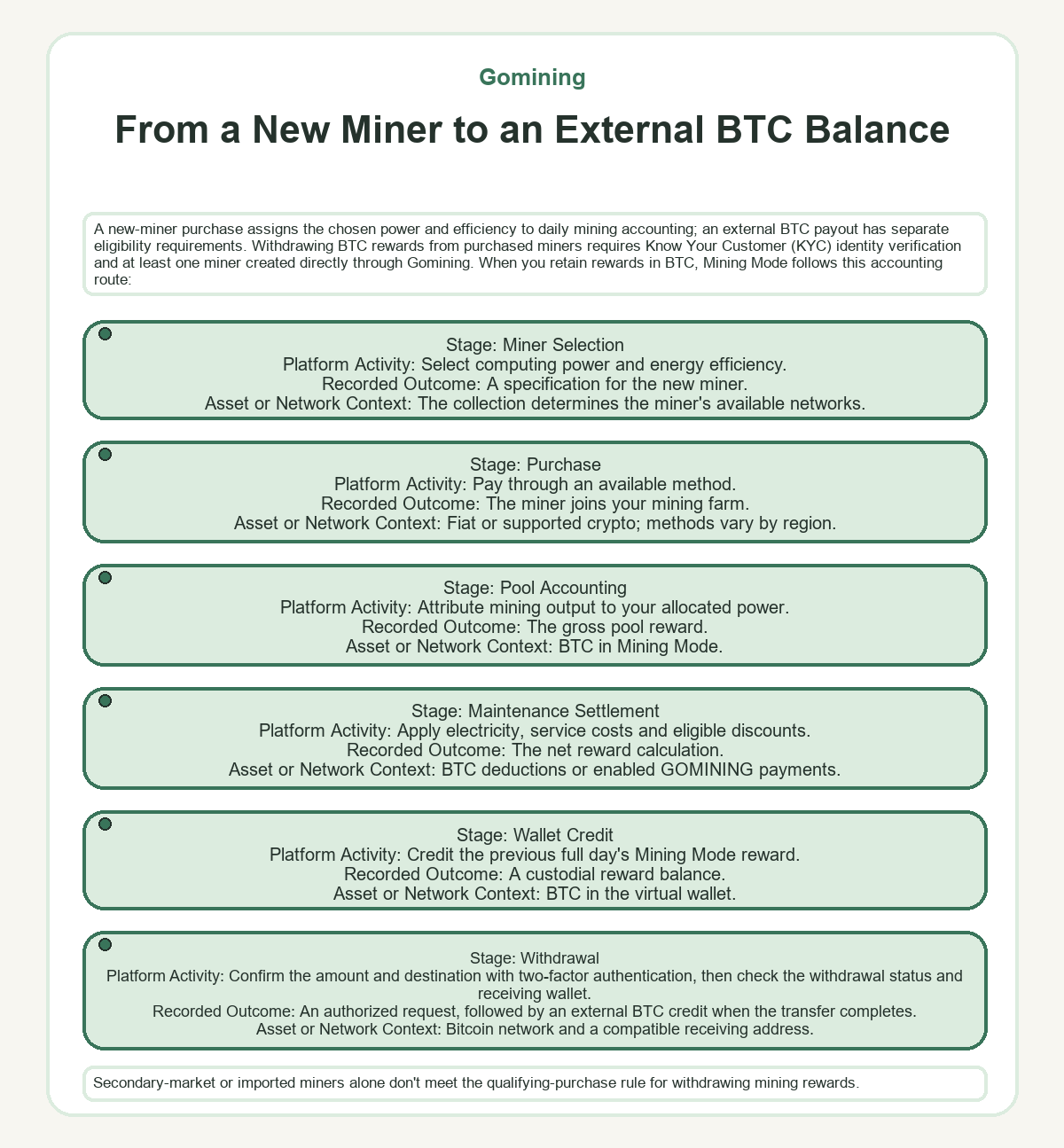
From a New Miner to an External BTC Balance
A new-miner purchase assigns the chosen power and efficiency to daily mining accounting; an external BTC payout has separate eligibility requirements. Withdrawing BTC rewards from purchased miners requires Know Your Customer (KYC) identity verification and at least one miner created directly through Gomining. When you retain rewards in BTC, Mining Mode follows this accounting route:
- Stage: Miner Selection Platform Activity: Select computing power and energy efficiency. Recorded Outcome: A specification for the new miner. Asset or Network Context: The collection determines the miner's available networks.
- Stage: Purchase Platform Activity: Pay through an available method. Recorded Outcome: The miner joins your mining farm. Asset or Network Context: Fiat or supported crypto; methods vary by region.
- Stage: Pool Accounting Platform Activity: Attribute mining output to your allocated power. Recorded Outcome: The gross pool reward. Asset or Network Context: BTC in Mining Mode.
- Stage: Maintenance Settlement Platform Activity: Apply electricity, service costs and eligible discounts. Recorded Outcome: The net reward calculation. Asset or Network Context: BTC deductions or enabled GOMINING payments.
- Stage: Wallet Credit Platform Activity: Credit the previous full day's Mining Mode reward. Recorded Outcome: A custodial reward balance. Asset or Network Context: BTC in the virtual wallet.
- Stage: Withdrawal Platform Activity: Confirm the amount and destination with two-factor authentication, then check the withdrawal status and receiving wallet. Recorded Outcome: An authorized request, followed by an external BTC credit when the transfer completes. Asset or Network Context: Bitcoin network and a compatible receiving address.
Secondary-market or imported miners alone don't meet the qualifying-purchase rule for withdrawing mining rewards.
What Changes the Bitcoin You Keep?
When you pay maintenance in BTC, your Mining Mode payout is the pool allocation less discounted electricity and equipment service costs. Paying with GOMINING instead preserves that BTC allocation while spending tokens separately. With Reward Protection enabled, payouts stop at zero when maintenance exceeds the reward. Electricity charges reflect the miner's power, its efficiency rating and the electricity price used for billing. At the same hashrate and electricity price, a lower W/TH rating reduces the electricity charge. Because the platform converts operating charges into BTC, Bitcoin's market price also affects the deduction. Network difficulty changes the gross mining output available to a given amount of hashrate.
The token-payment discount can reach 20% under the maintenance-coverage tiers. It requires enabling GOMINING maintenance payments and keeping enough spendable tokens in the virtual wallet. Locked tokens can contribute to the coverage calculation, but they can't pay the bill. An insufficient liquid balance means BTC deductions without that token-payment discount. VIP benefits and the Service button provide separate discounts under their own rules. A discount lowers ongoing expenses; the purchase and upgrade prices still determine the capital that net earnings must recover.
Hashrate Growth and Reward Choices
Power upgrades increase a miner's TH/s, while efficiency upgrades lower the electricity demand assigned to the same amount of power. Buying additional hashrate also increases the operating costs associated with that power. An efficiency upgrade reduces electricity costs, and future savings would need to cover its quoted purchase cost.
Automatic reinvestment can use mining BTC to buy additional power for one eligible miner or purchase GOMINING tokens for the virtual wallet. TH reinvestment uses the upgrade price available when it runs and adds no extra reinvestment fee. Token reinvestment charges 2.25%. Neither option leaves the converted reward as withdrawable BTC.
A Miner Subscription adds power through recurring payments. An active subscription restricts selling, withdrawing or minting the affected miner and prevents selecting it for TH reinvestment. Its eligibility rules differ from those for reinvestment, so these features aren't interchangeable growth settings.
GOMINING Voting and Miner Wars
GOMINING is the platform's utility token for maintenance payments, marketplace purchases and game features. Locking it creates veGOMINING voting power and eligibility for weekly token rewards. Holders vote on token reissuance and the allocation of ecosystem rewards. Supported locking routes include an Ethereum wallet and the in-app wallet. Ethereum locks require network fees and manual reward claiming unless auto-claim is enabled. In-app locks credit rewards automatically. Both routes send GOMINING rewards to the virtual wallet. Locked tokens remain unavailable until the agreed lock expires. The Burn & Mint mechanism connects maintenance-token spending with weekly burns, new issuance and ecosystem reward allocations.
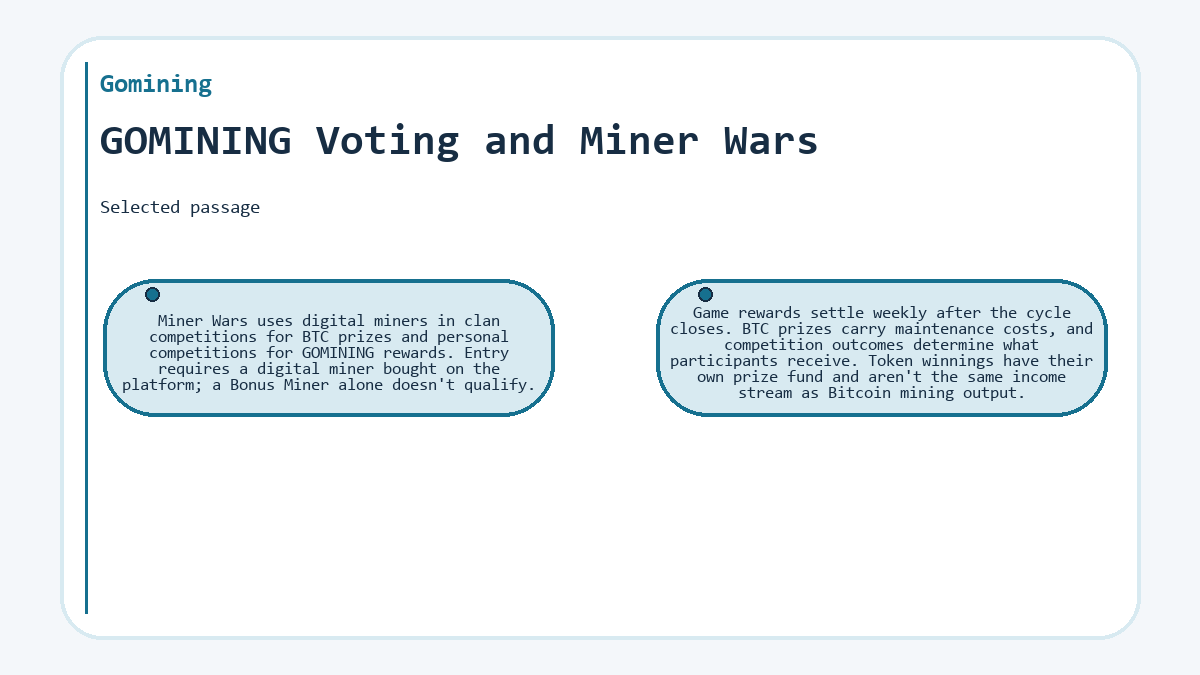
Miner Wars uses digital miners in clan competitions for BTC prizes and personal competitions for GOMINING rewards. Entry requires a digital miner bought on the platform; a Bonus Miner alone doesn't qualify. Game rewards settle weekly after the cycle closes. BTC prizes carry maintenance costs, and competition outcomes determine what participants receive. Token winnings have their own prize fund and aren't the same income stream as Bitcoin mining output.
Joining a clan changes the farm to Game Mode and removes the Mining Mode reward for that UTC day. Leaving restores Mining Mode; daily BTC payouts resume after one complete UTC day in that mode.
Referral commissions and Bounty task rewards are additional programs with their own qualifying activities; they aren't the miner's pool allocation.
Wallet Services Beyond Mining
The custodial wallet holds BTC, GOMINING, USDT, USDC and other supported assets off-chain. Each asset has its own deposit networks and minimums. Deposits below the stated transaction minimum can't be recovered. The withdrawal screen shows the relevant network, amount limits and fees before confirmation.
Optional Simple Earn allocates supported balances across managed decentralized finance (DeFi) strategies. It requires KYC Basic and residence in an eligible jurisdiction. The annual percentage rate varies with the asset and earning conditions. Simple Earn doesn't impose a fund lockup, although the wallet's withdrawal checks still apply. Simple Earn rewards are separate from mining output and arrive in BTC by default. You can instead convert qualifying rewards into power for one eligible miner. Smart contract vulnerabilities can cause losses in the underlying strategies.
The virtual Visa debit card converts selected BTC, GOMINING, USDT or USDC into the payment currency. The card supports Apple Pay and Google Wallet; eligible cashback adds mining power. Issuing and using it require KYC Basic, KYC Advanced and eligible residency. The first card also requires at least $100 of combined wallet balances. Hotel bookings through Travel can use wallet balances and earn eligible TH cashback.
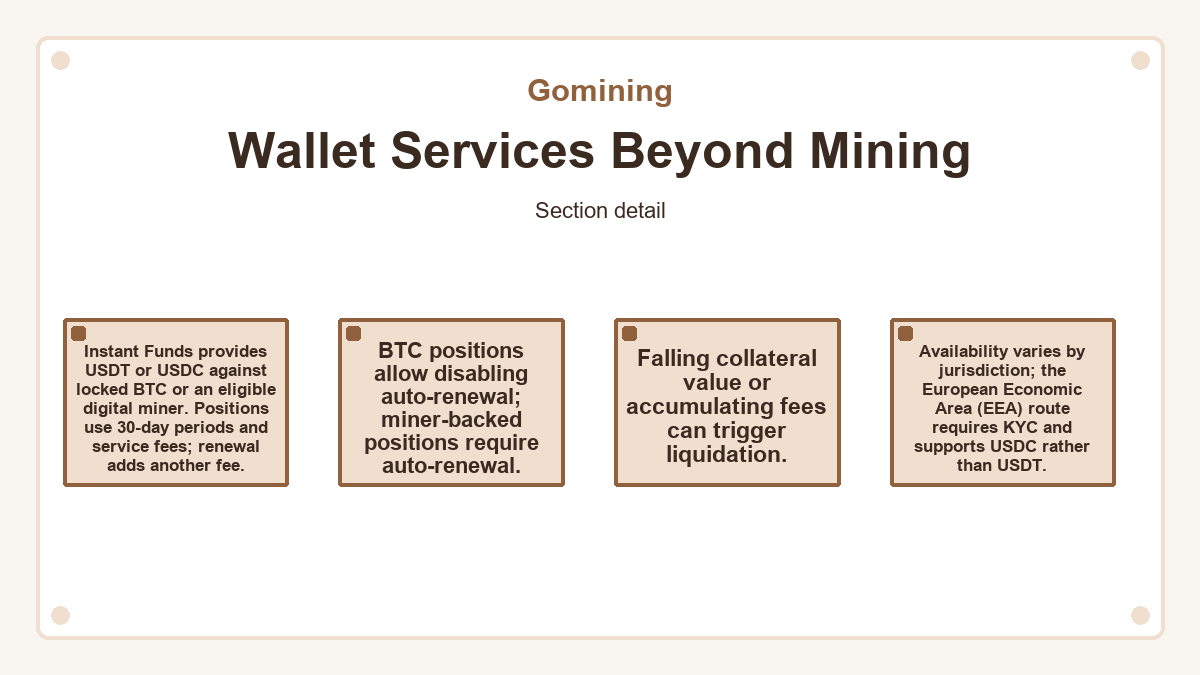
Instant Funds provides USDT or USDC against locked BTC or an eligible digital miner. Positions use 30-day periods and service fees; renewal adds another fee. BTC positions allow disabling auto-renewal; miner-backed positions require auto-renewal. Falling collateral value or accumulating fees can trigger liquidation. Availability varies by jurisdiction; the European Economic Area (EEA) route requires KYC and supports USDC rather than USDT.
Launchpad supports token sales for Bitcoin-focused projects, with KYC and at least Silver I VIP status required for participation. The ecosystem also includes mining education and AI connectors for accessing account data. These services have distinct purposes and conditions beyond owning a miner.
What Are the Risks of Owning a Digital Miner?
Digital miner ownership carries risks from operator dependence, changing mining conditions and uncertain resale demand. Mining also depends on equipment and platform administration when the NFT sits in an external wallet. Transferring the NFT changes where you hold the ownership record; it doesn't transfer a physical machine into your possession. Interruptions to hashrate or account services can affect earnings and access. Custodial wallet balances add a separate reliance on the platform handling your assets and transfers.
Existing miner holders can buy resale miners through the platform marketplace, which uses GOMINING settlement. Mine Now, Pay Later offers a separate primary-purchase route where available. Mining continues while installments meet the repayment schedule. During the plan, selling, minting and upgrades remain restricted. Upgrades unlock after the final payment; selling and minting wait another 90 days. Missed payments can pause mining and eventually put ownership of that miner at risk.
A resale listing needs a willing buyer; its asking price can't guarantee a sale or recovery of the original purchase cost. Buying BTC directly avoids the miner purchase and ongoing mining deductions. Operating physical hardware gives you responsibility for power contracts, cooling and repairs. Hosted digital mining places that work with the operator and leaves the mining allocation subject to its operating terms.
Common questions, answered
Does an in-app Purchase Delay Selling or Withdrawing a Miner?
Purchases through Apple, Google or Ecommpay can require up to 90 days of purchase verification before you can sell or withdraw the digital miner. During verification, the platform prevents listing that miner or sending its NFT to an external wallet. BTC rewards from purchased miners follow separate identity-verification and direct-purchase requirements for withdrawal.
How Long Do Withdrawals Pause After an Account Security Change?
Security mode pauses wallet withdrawals and miner sales for 12 hours after changing your email or password, or disabling two-factor authentication. Mining, reward credits and deposits continue during the hold. The affected withdrawal or selling screen displays the remaining time. Support can restore access earlier after confirming that the request comes from you; changing credentials yourself doesn't automatically bypass the hold.
Can I Withdraw Bonus Miner Rewards Without Purchasing a Miner?
Opening the platform's card provides an alternative to buying a miner directly for Bonus Miner reward withdrawal eligibility. A secondary-market miner doesn't satisfy the direct-purchase route. A first card requires KYC Basic, KYC Advanced, eligible residency and at least $100 across wallet assets. Bonus Miner versions and task terms can differ between accounts. If you haven't bought a miner, Bonus Miner rewards more than 90 days old expire automatically.
What Happens to Power Upgrades If I Cancel a Miner Subscription?
Canceling a Miner Subscription stops future monthly power upgrades while preserving every TH already added to the miner. The subscription bonus resets when you cancel, so resubscribing starts its progression again.
Is Simple Earn Available to U.S. Residents?
Simple Earn isn't available to residents of the United States or certain other excluded jurisdictions. Completing KYC Basic or holding a supported asset doesn't override that regional restriction. Wallet services, digital miners and the card follow their own product rules, so the Simple Earn exclusion shouldn't be treated as a single availability rule for every Gomining feature.
Updated -